


Caftan or takchita: what is the difference?
One robe or two layers: how to tell a caftan from a takchita, and which one to choose.
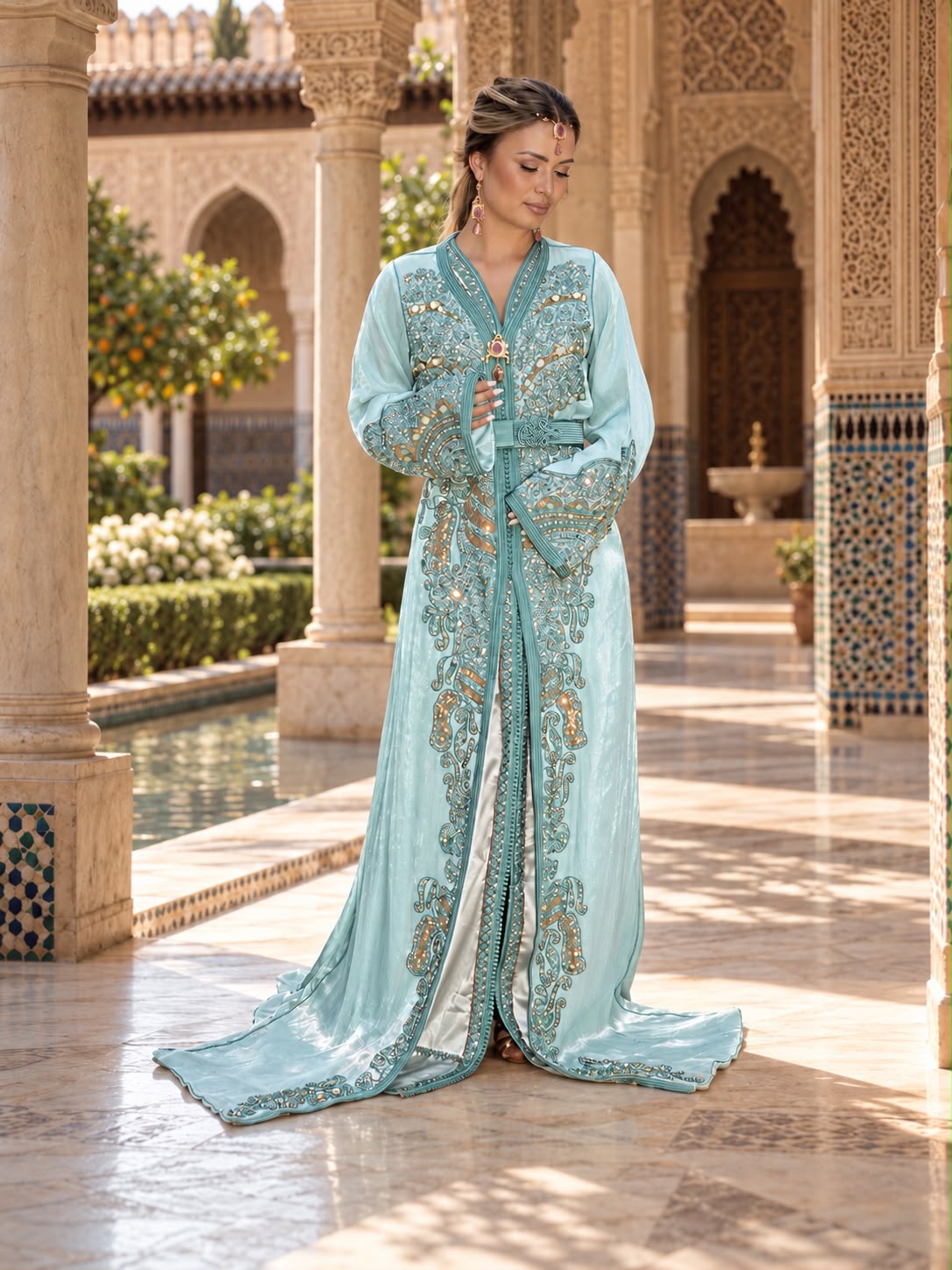
When people search for the name of the Moroccan dress, two words come up: caftan and takchita. Both are long, both are worked by hand, and both are worn for weddings and celebrations. The difference is in how they are built.
The caftan: one robe
A caftan is a single long robe, cut straight and closed down the front. Its beauty lives in the cloth and in the finishing: brocade, satin or hriri, edged with sfifa, the hand-braided trim, and closed with aakad, small knot buttons. Almaz, in hrir brocade with pearl tarz at the cuffs and neckline, is a caftan.
The takchita: two layers
A takchita is worn in two layers: a base dress and an over-dress, often lighter or more open, which lets the inner layer show at the front and the sleeves. A belt, the mdama, gathers both at the waist. Zelaya is a takchita: silk chiffon over an inner piece in satin, with its mdama worked in sfifa.
The words of the craft
- Sfifa: the braided silk cord that edges the neckline and the front.
- Aakad: the knot buttons, tied one by one.
- Mdama: the belt that defines the waist.
- Tarz: hand embroidery, often with stones, pearls or crystals.
- Maâlem: the master artisan who carries the technique.
Which one should you choose?
A caftan has a clean, continuous line and feels lighter to wear through a long evening. A takchita has more volume and movement, with the play of two layers, and is often chosen for the most formal moments. Both can be bought or rented at AZRA: see the collection or our rental pieces.